Sauvons les animaux: a bilingual, sourced and honest guide to species on the brink of extinction
An information site in French and English about ten species listed as Critically Endangered by the IUCN: dated and sourced population figures, clear explanations of threats and conservation successes, and direct links to the organizations working in the field.
The project
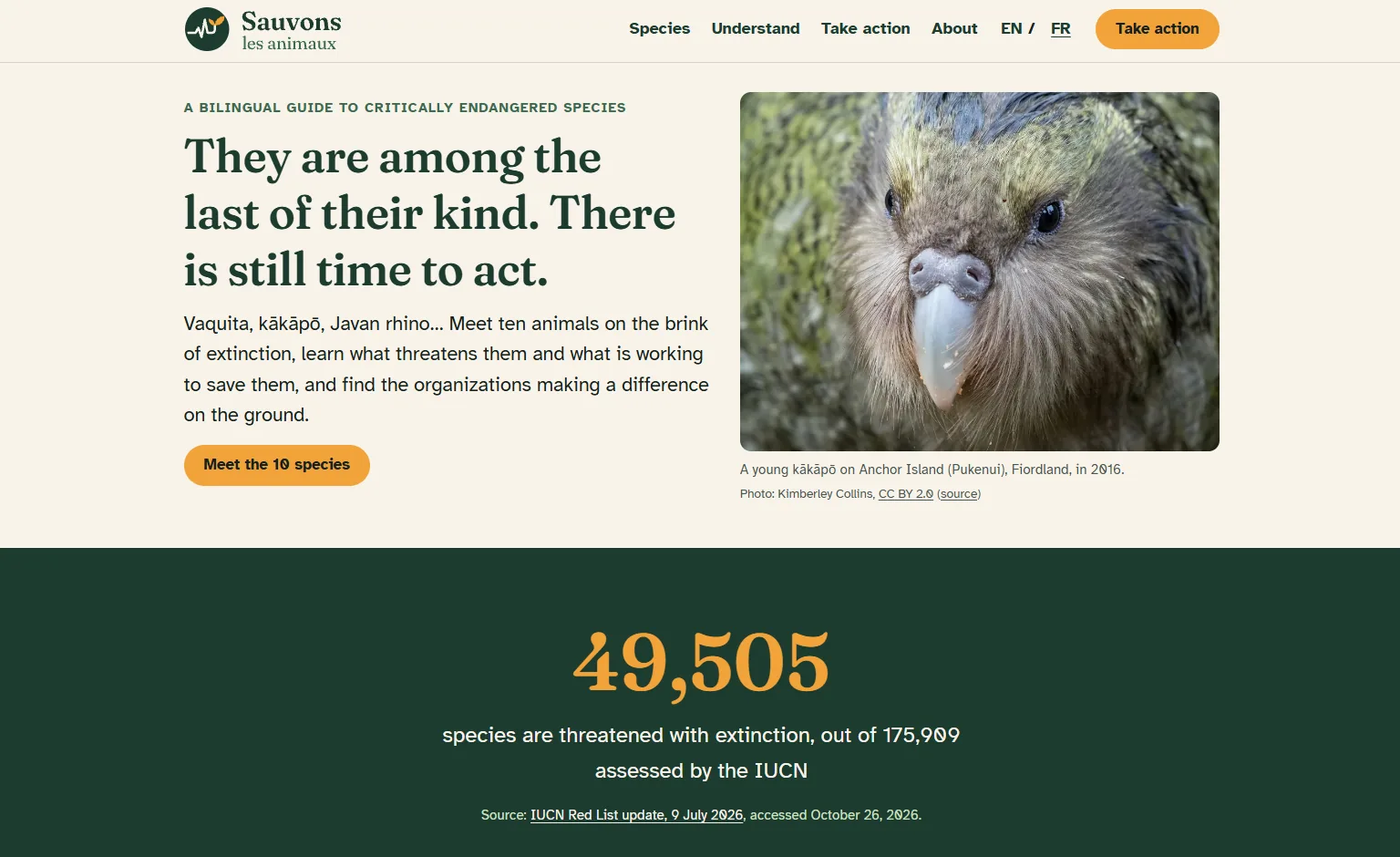
Sauvons les animaux ("Let's save the animals") profiles ten species listed as Critically Endangered on the IUCN Red List: the vaquita, the kakapo, the Javan rhino, the Hainan gibbon, the axolotl, the North Atlantic right whale and more. For each one, the site gives the latest published population figure, explains what threatens it, and points visitors to the organizations working in the field. The site collects no donations, shows no ads and earns no commissions.
The challenge
- Be credible on a sensitive topic. Figures about endangered species often circulate with no source or date. Every number had to be verifiable.
- Stay current. Populations change and the IUCN publishes new assessments, so content has to be easy to revise.
- Reach two audiences. The site speaks to French and English speakers alike, with a complete version in each language.
- Inspire action without guilt-tripping, and without routing visitors' money through a middleman.
What we built
Ten consistent species profiles
Each species has a card and a page: photo, conservation status, group (mammal, bird, reptile, amphibian, fish), scientific name and estimated population with its year. The list can be sorted by population or by name, so the most fragile species stand out at a glance.
Sourced and dated data
Each page shows the year of the IUCN assessment, the year of the population figure and the date it was last checked, then lists its sources at the bottom. When sources disagree, the site explains why instead of picking the most dramatic number. A methodology page sets out how the species were selected.
Understand, then act
The "Understand" section explains the main threats (habitat loss, hunting and trade, populations that are too small) and shows that conservation works, with successes such as the kakapo and the Iberian lynx. The "Act" section offers three concrete ways to help: supporting field organizations, changing some habits and sharing the information.
Honest images
Photos are openly licensed or in the public domain, with the author, licence and a link to the original under each image. No AI-generated image depicts a real animal.
Bilingual from end to end
French and English each have their own URLs (/fr/ and /en/), a FR / EN switcher on every page, and the tags that tell Google which page is the equivalent in the other language.
Under the hood
- Astro: static pages generated ahead of time, very light and fast, even on an old phone.
- Structured content: each species is a file with its own fields (status, population, year, sources), which keeps every profile consistent and makes updates easy.
- Cloudflare: global hosting and email addresses protected from bots.
- Accessibility and sharing: a skip link to the main content, and share images for Facebook and other networks.
Planning a similar project?
Tell us about your business. Free, detailed quote within 2 business days.